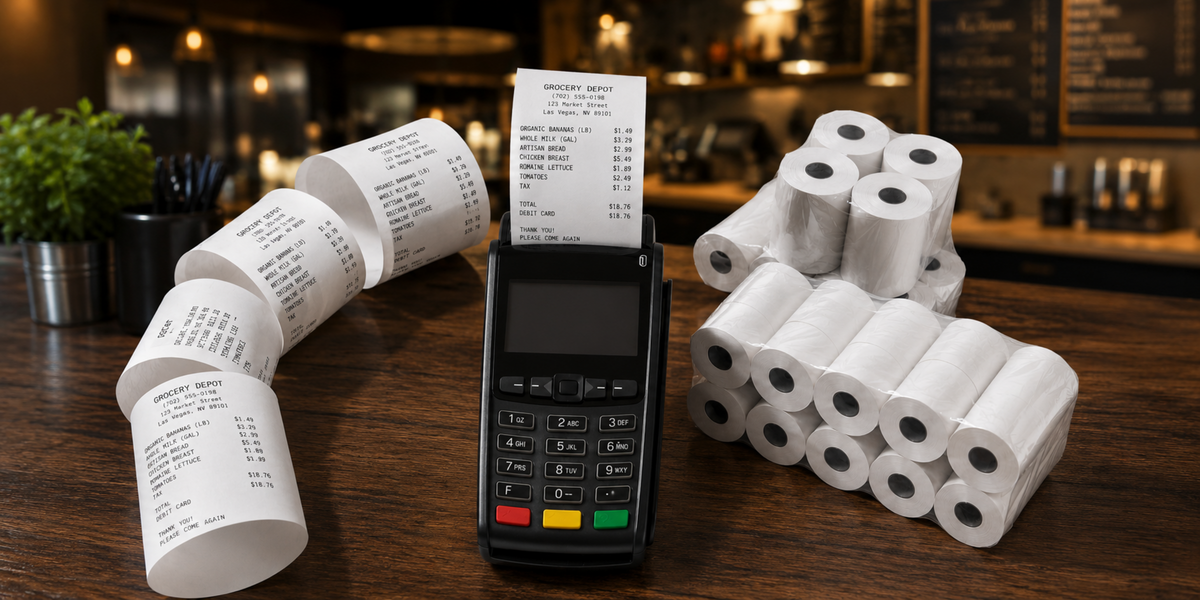
The Complete Guide to Thermal Receipt Paper
Thermal receipt paper powers millions of daily transactions across retail, restaurants, grocery, healthcare, hospitality, banking, warehousing, and mobile payment environments.
This guide explains how thermal paper works, the most common roll sizes, BPA-free formulations, printer compatibility, storage, receipt lifespan, common problems, and how to choose dependable paper for your business.

What You’ll Learn
- What thermal receipt paper is
- How direct thermal printing works
- Thermal paper versus bond paper
- BPA-free thermal paper
- Common receipt-roll sizes
- Printer compatibility
- Receipt lifespan and storage
- Common printing problems
- Industries that use thermal paper
- How to choose premium receipt rolls
What Is Thermal Receipt Paper?
Thermal receipt paper is a specially coated paper that creates text and images when exposed to heat. A direct thermal printer uses a heated printhead to activate the coating, so no ink cartridge, toner, ribbon, or printing plate is required.
This process produces sharp, high-contrast receipts quickly and quietly, making thermal printing a preferred technology for many modern point-of-sale systems.
Common Applications
- Retail and grocery receipts
- Restaurants and cafés
- Pharmacies and healthcare
- Hotels and hospitality
- Payment terminals and kiosks
- Warehousing and logistics
Why Businesses Use It
- Fast printing speeds
- Quiet operation
- Crisp, readable receipts
- Low routine maintenance
- Reliable high-volume performance
- Lower ongoing consumable costs
How Does Thermal Receipt Paper Work?
Thermal receipt paper contains a heat-sensitive coating. Inside the printer, thousands of microscopic heating elements selectively heat the paper as it passes beneath the printhead.
The printer advances the coated paper beneath the printhead.
Specific points on the printhead heat according to the receipt data.
Heat forms text, logos, barcodes, QR codes, and graphics directly on the paper.
No drying time, ink, toner, or ribbon replacement is required.
Is Thermal Receipt Paper Safe?
Modern thermal paper is available in several formulations, including BPA-free options used by retailers, restaurants, healthcare providers, financial institutions, and other commercial organizations.
Many businesses choose BPA-free receipt paper because it delivers reliable print performance without using BPA in the thermal coating.
Benefits of BPA-Free Thermal Paper
- BPA-free formulation
- Crisp, high-quality printing
- Reliable barcode scanning
- Low printer dust
- Strong image durability
- Broad POS compatibility
What to Check Before Buying
- Clearly listed paper specifications
- Correct width and roll diameter
- Core size
- Printer compatibility
- Packaging and storage quality
- Reliable supplier information
How Long Does Thermal Receipt Paper Last?
Receipt lifespan depends on paper quality, storage conditions, and exposure to heat, sunlight, humidity, oils, solvents, and certain plastics.
To help preserve image quality:
- Store rolls in a cool, dry location
- Avoid direct sunlight
- Keep paper away from excessive heat and humidity
- Protect receipts from oils, solvents, and plasticizers
- Keep unused rolls in their original packaging
Common Thermal Receipt Paper Sizes
Two widths are especially common in North American businesses: 2-1/4 inches and 3-1/8 inches. Width alone is not enough—roll diameter, core size, paper thickness, and roll length also matter.
2-1/4-Inch Thermal Receipt Paper
Also called 57 mm or 58 mm paper. Commonly used in compact payment terminals and portable POS devices.
- Credit-card terminals
- Mobile payment printers
- Handheld POS systems
- Portable receipt printers
- Taxi and delivery devices
3-1/8-Inch Thermal Receipt Paper
Also called 80 mm paper. Commonly used in full-size countertop POS receipt printers.
- Restaurants and cafés
- Retail and grocery stores
- Pharmacies and hotels
- Convenience stores
- Self-checkout systems
| Paper Size | Metric Width | Common Use | Typical Printer Type |
|---|---|---|---|
| 2-1/4 inch | 57–58 mm | Payment terminals and mobile POS systems | Compact or handheld printer |
| 3-1/8 inch | 80 mm | Retail, restaurant, and grocery receipts | Full-size countertop POS printer |
How to Choose the Correct Receipt Roll
The safest method is to check the printer manufacturer’s specifications or the label inside the paper compartment.
1. Confirm Width
Verify whether the device requires 2-1/4-inch or 3-1/8-inch paper.
2. Check Diameter
Make sure the full roll fits inside the printer compartment.
3. Check Core Size
Confirm the centre opening or tube specification.
4. Confirm Paper Type
Verify that the printer requires direct thermal paper rather than bond paper.
5. Compare Roll Length
Longer rolls may reduce changes but must still fit the printer.
6. Verify Model Compatibility
Use the exact printer model, not the brand name alone.
Thermal Receipt Paper Printer Compatibility
Compatibility depends on the exact paper width, roll diameter, core size, and thermal-printing requirements of the device.

Compact Payment Terminals
These devices commonly use 2-1/4-inch thermal paper.
- Verifone
- Ingenico
- Clover
- PAX
- First Data
- Moneris
Full-Size POS Printers
These printers commonly use 3-1/8-inch thermal paper.
- Epson
- Star Micronics
- Bixolon
- Citizen
- NCR
- Sharp

Industries That Use Thermal Receipt Paper

Retail Stores
- Sales receipts
- Returns and exchanges
- Gift receipts
- Loyalty programs
- Promotional coupons

Restaurants & Cafés
- Customer receipts
- Kitchen order tickets
- Bar receipts
- Drive-thru orders
- Pickup orders

Grocery Stores
- Fast checkout
- Itemized receipts
- Barcode support
- Promotional messaging
- Long receipts

Pharmacies & Healthcare
- Prescription receipts
- Payment confirmations
- Patient transactions
- Pharmacy purchases

Hotels & Hospitality
- Guest receipts
- Restaurant bills
- Parking receipts
- Gift-shop purchases
- Service charges

Warehouses & Distribution
- Shipping labels
- Inventory tracking
- Packing slips
- Warehouse receipts
- Barcode scanning
Common Problems With Thermal Receipt Paper
Faded Printing
Possible causes: Low-quality paper, heat exposure, direct sunlight, or old paper.
Solution: Use premium paper and store rolls in a cool, dry environment.
Paper Jams
Possible causes: Wrong diameter, incorrect core size, damaged edges, or inconsistent paper.
Solution: Verify the printer specifications before ordering.
Blank Receipts
Possible causes: Paper installed backwards, incorrect paper type, or printer settings.
Solution: Flip the roll so the coated side faces the printhead.
Poor Print Quality
Possible causes: Dirty printhead, weak paper coating, or incorrect settings.
Solution: Clean the printer and use consistent, high-quality thermal paper.
Frequently Asked Questions
Is thermal receipt paper the same as regular receipt paper?
No. Thermal paper has a heat-sensitive coating and prints without ink. Bond paper requires an ink ribbon or impact printer.
Do thermal printers require ink?
No. Direct thermal printers use heat to form the image directly on coated paper.
How can I tell if my printer uses thermal paper?
Check the printer manual or lightly scratch the paper with a fingernail. A dark mark usually indicates thermal paper.
Is BPA-free thermal paper better?
Many businesses prefer BPA-free paper because it avoids BPA in the coating while still delivering clear, dependable printing.
How long do thermal receipts last?
Premium receipts can remain readable for years when stored away from heat, sunlight, moisture, oils, and certain plastics.
Why do receipts fade?
Heat, sunlight, humidity, oils, solvents, and plasticizers can affect the thermal image.
Can thermal paper be recycled?
Recycling rules vary by municipality. Check with your local recycling provider.
What size paper do I need?
2-1/4-inch paper is common for payment terminals, while 3-1/8-inch paper is common for full-size POS printers. Always verify the exact printer model.
Why Businesses Choose VANTROO
Businesses rely on receipt paper every day, so consistency matters. Reliable paper helps reduce printer interruptions, supports clear transaction records, and keeps checkout operations running efficiently.
VANTROO focuses on premium BPA-free thermal receipt paper engineered for clear printing, smooth feeding, broad printer compatibility, and dependable commercial use.
Shop Premium Thermal Receipt Paper
Choose Receipt Paper Your Business Can Rely On
The correct paper size, dependable coating quality, proper storage, and verified printer compatibility all help produce clear receipts while reducing downtime and waste.
Shop VANTROO Thermal Receipt Paper