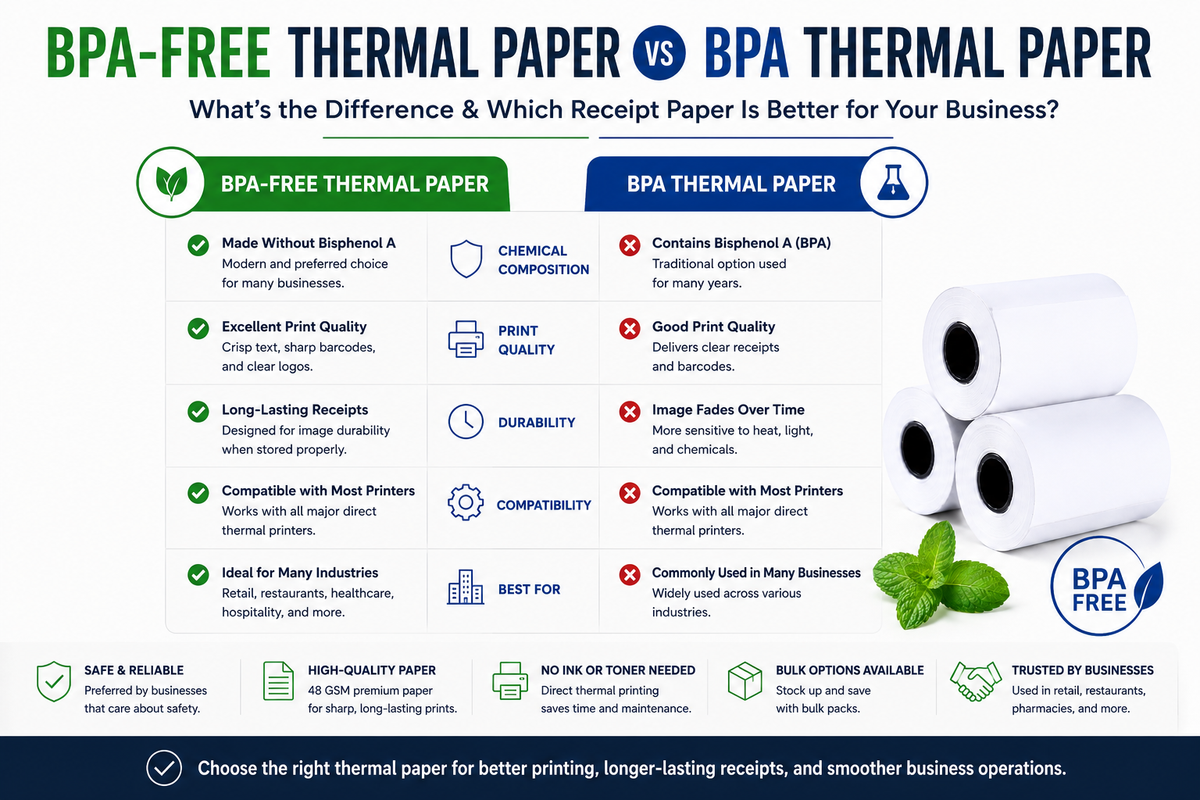
BPA-Free Thermal Paper vs BPA: What’s the Difference?
Businesses process billions of receipts every year, and most are printed on thermal paper. As receipt-paper standards and purchasing preferences evolve, many organizations are asking what BPA is, how BPA-free thermal paper differs, and whether the change affects print quality or printer compatibility.
This guide explains the differences between traditional BPA thermal paper and BPA-free thermal paper, including coating technology, print performance, storage, durability, compatibility, business applications, and purchasing considerations.
New to thermal receipt paper? Start with our Complete Guide to Thermal Receipt Paper for an overview of thermal printing, roll sizes, and printer compatibility.

What You’ll Learn
- What BPA is and why it was historically used in thermal paper
- How BPA-free thermal paper works
- The primary differences between BPA and BPA-free formulations
- Print-quality, durability, and compatibility considerations
- Common myths about BPA-free receipt paper
- Which industries commonly use BPA-free thermal paper
- How to choose the right paper for your printer and business
What Is BPA?
Bisphenol A, commonly called BPA, is an industrial chemical that has been used in certain plastics and specialty coatings. In traditional thermal receipt paper, BPA historically served as part of the heat-reactive coating that allows text and images to appear when the paper contacts a thermal printhead.
During printing, controlled heat activates the coating and creates black text, barcodes, logos, and transaction details without ink, toner, or ribbons.
BPA-based thermal paper became common because it offered consistent image development, dependable print contrast, and reliable performance across many receipt-printer models.
Why Was BPA Used in Thermal Receipt Paper?
Thermal coatings require a developer that reacts when heated. BPA was widely used because it supported:
Performance Benefits
- Consistent image development
- Sharp, high-contrast printing
- Fast thermal response
- Reliable use in high-speed POS printers
Commercial Benefits
- Broad printer compatibility
- Stable manufacturing performance
- Long-lasting print under proper storage
- Cost-effective large-scale production
What Is BPA-Free Thermal Paper?
BPA-free thermal paper uses alternative heat-reactive developers instead of BPA. These modern coatings are engineered to produce the crisp, high-contrast printing expected from direct thermal printers while meeting the purchasing standards of businesses seeking BPA-free options.
High-quality BPA-free thermal paper can provide:
- Crisp, easy-to-read text
- Sharp barcodes and clear graphics
- Smooth feeding through compatible printers
- Consistent performance in high-volume environments
- Long-lasting images when stored properly
- Broad compatibility with modern thermal printers
BPA-Free Thermal Paper vs Traditional BPA Thermal Paper
At first glance, the two paper types appear almost identical. Both are designed for direct thermal printing and both create receipts without ink or toner. The key difference is the developer used inside the heat-sensitive coating.

| BPA-Free Thermal Paper | Traditional BPA Thermal Paper |
|---|---|
| Uses alternative heat-reactive developers | Uses BPA in the thermal coating |
| Compatible with modern direct thermal printers | Compatible with modern direct thermal printers |
| Produces sharp, high-contrast printing | Produces sharp, high-contrast printing |
| Requires no ink, toner, or ribbon | Requires no ink, toner, or ribbon |
| Widely selected by many modern businesses | Historically common across many industries |
Print Quality Comparison
A common misconception is that BPA-free thermal paper produces weaker or less readable receipts. Premium BPA-free paper is engineered to provide excellent print clarity when paired with a compatible, properly maintained thermal printer.
High-Quality Output
- Crisp black text
- Sharp, scannable barcodes
- Clear logos and graphics
- Consistent print density
What Affects Results Most
- Paper manufacturing quality
- Printer-head condition
- Correct printer settings
- Proper paper storage

Durability and Image Life
Businesses may need receipts to remain readable for returns, accounting, warranty claims, and transaction records. Premium thermal paper can produce durable images when stored correctly.
To help preserve receipts:
- Store rolls in a cool, dry location
- Keep receipts away from direct sunlight
- Avoid excessive heat and humidity
- Protect receipts from oils, solvents, and plasticizers
- Keep unused rolls in their original packaging
Printer Compatibility
BPA-free thermal paper is designed to work with direct thermal receipt printers when the width, roll diameter, core size, and paper grade match the printer’s requirements.
Compatible printer and POS brands commonly include:
- Epson
- Star Micronics
- Bixolon
- Citizen
- NCR
- Clover
- Square
- Verifone
- Ingenico
- PAX
Cost and Purchasing Considerations
Receipt paper is a small but important operating expense. The lowest purchase price does not always provide the best long-term value if the paper causes jams, inconsistent feeding, weak print density, or premature roll changes.
Compare products using:
- Print quality and coating consistency
- Roll length and paper weight
- BPA-free formulation
- Packaging quality
- Printer compatibility
- Supplier reliability
Who Should Choose BPA-Free Thermal Paper?
BPA-free thermal receipt paper is a strong choice for organizations that want dependable printing performance combined with modern paper formulations.
Best For Businesses That Value
- Reliable day-to-day performance
- Crisp, professional receipts
- Consistent barcode scanning
- High-volume printing
- Broad printer compatibility
Common Purchasing Priorities
- BPA-free specifications
- Consistent roll dimensions
- Smooth feeding
- Strong protective packaging
- Dependable supplier support
Industries That Use BPA-Free Thermal Paper
Retail Stores
Sales receipts, returns, exchanges, loyalty programs, coupons, and gift receipts.
Restaurants & Cafés
Customer receipts, counter service, takeout, drive-thru, and payment confirmations.
Grocery Stores
Checkout receipts, self-checkout, promotions, itemized purchases, and returns.
Pharmacies & Healthcare
Pharmacy purchases, front-desk payments, store transactions, and payment receipts.
Hospitality
Guest receipts, restaurant transactions, parking payments, retail purchases, and service charges.
Warehousing & Logistics
Transaction records, labels, inventory activity, payment confirmations, and service documentation.
Common Myths About BPA-Free Thermal Paper
Myth: BPA-Free Paper Does Not Print as Well
RealityPremium BPA-free thermal paper can produce crisp text, sharp barcodes, and excellent print quality in compatible printers.
Myth: BPA-Free Paper Does Not Last
RealityProperly manufactured paper can maintain readable images for years when stored in a cool, dry environment away from heat and chemicals.
Myth: All Thermal Paper Is the Same
RealityThermal paper varies in coating quality, durability, roll dimensions, packaging, paper weight, and manufacturing consistency.
Choosing the Right BPA-Free Thermal Paper
Look for products that offer:
- Clearly identified BPA-free paper
- Premium, consistent paper quality
- Correct width, diameter, length, and core size
- Smooth printer feeding
- Crisp print clarity and reliable barcode performance
- Strong packaging for shipping and storage
- Compatibility with your specific printer model
Frequently Asked Questions
Is BPA-free thermal paper compatible with my printer?
Usually, yes. Choose the paper width, diameter, core size, and grade required by your direct thermal printer.
Does BPA-free paper print as clearly as traditional paper?
High-quality BPA-free paper can produce crisp text, sharp barcodes, and clear graphics. Manufacturing quality and printer condition matter more than the BPA-free designation alone.
Do thermal printers require ink or toner?
No. Direct thermal printers create images by heating specially coated thermal paper.
How can I identify thermal paper?
Gently scratching the coated side with a fingernail often leaves a dark mark. You can also confirm the paper type through its packaging or your printer documentation.
How should thermal receipt paper be stored?
Store it in a cool, dry location away from sunlight, heat, humidity, oils, solvents, and certain plastics.
What are the most common receipt-paper widths?
2-1/4 inch (57–58 mm) is common for compact payment terminals, while 3-1/8 inch (80 mm) is common for full-size POS receipt printers.
Why Businesses Choose VANTROO
Businesses depend on receipt paper every day. Reliable paper supports clear printing, smooth checkout operations, and fewer interruptions caused by jams or inconsistent feeding.
VANTROO supplies premium BPA-free thermal receipt paper designed for professional use across retail, restaurants, healthcare, hospitality, grocery, warehouse, and payment-terminal environments.
Explore VANTROO Thermal Receipt Paper
Choose Dependable BPA-Free Thermal Paper
Selecting the correct roll size, storing paper properly, and choosing consistent manufacturing quality can help your business produce clear receipts and reduce printing interruptions.
Shop VANTROO Thermal Receipt PaperRelated reading: BPA-free vs regular thermal paper · BPA-free receipt paper for restaurants and retail.
